About Us
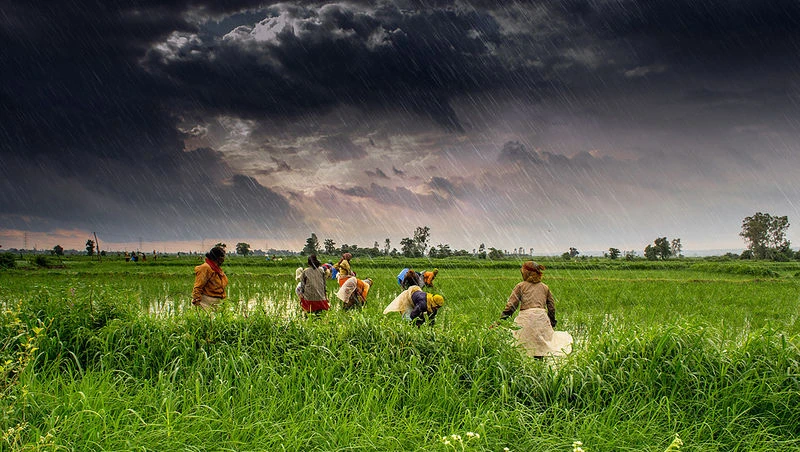
The Indian summer (southwest) monsoon is referred as lifeline of India, as variability in any of its aspects (onset, withdrawal and quantum of rainfall) greatly influences the agriculture yield, economy, water resources, power generation and ecosystem. Hence, if the variations in monsoon rainfall are known well in advance, it would be possible to reduce the adverse impacts related to excess or deficient rainfall, providing us prior information about droughts and floods. The accurate prediction of monsoon rainfall is a basic need for the nation but remained a challenge over the decades. The long range prediction of the seasonal mean monsoon rainfall depends on dynamics of its year-to-year variations. Recent improvements in dynamical numerical models with ocean-atmosphere coupling has been useful for improvement of the monsoon forecast skill through a collective effort.
- Ministry of Earth Sciences (MoES), Government of India launched 'National Monsoon Mission' (NMM) in 2012 with a vision to develop a state-of-the-art dynamical prediction system for monsoon rainfall on different time scales. MoES bestowed the responsibility of execution and coordination of this mission to the Indian Institute of Tropical Meteorology (IITM), Pune. For this national mission, IITM is collaborating with NCEP (USA), MoES organisations and various academic institutions/organizations under NMM. Climate Forecast System (CFS) of NCEP, USA has been identified as the basic modelling system for the above purpose, as it is one of the best among the currently available coupled models. However, it had a moderate skill for retrospective forecast (hindcast) of seasonal monsoon rainfall and this skill needed to be improved to make the forecasts more useful. Thus, there was an urgent need to develop an Indian model based on CFS coupled model with an improved hindcast skill so that it can be transferred to the India Meteorological Department for operational forecasting. With this objective, and to accomplish this task, MoES/IITM invited proposals from national and international scientists/organizations. Through model development works at IITM, the skill of the model has improved and it has been transfered to IMD. Base Models used
- The Ministry of Earth Sciences (MoES) has considered to use the following numerical models : (i) The American model called “Climate Forecast System” (CFS) developed by National Centres for Environmental Prediction (NCEP), NOAA National Weather Service, USA. CFS is a coupled ocean-atmosphere modeling system that combine data from ocean, atmosphere and land for providing long range forecasting (seasonal prediction of Indian Monsoon); [ Model developments on CFS will be implemented by IITM, with atmospheric initial conditions from NCMRWF and Ocean initial conditions from INCOIS] and (ii) The Unified Model (UM), developed by the United Kingdom Meteorological Office (UKMO), UK. This model will be utilized for short to medium range prediction [and the Model developments on UKMO will be implemented by NCMRWF, in association with IMD.] Need for NMM
- El Nino and Southern Oscillation (ENSO) being a dominant mode of global inter-annual variability and due to its vast influence on other regional climates, in last few decades researchers have made large number of studies on the ENSO phenomena and its various impacts using atmospheric and ocean-atmosphere coupled general circulation models. In recent decades, dynamical numerical models have considerably improved and most of the global coupled models have shown good prediction skill of ENSO SST with six months lead time. The seasonal mean rainfall hindcast skill, at one season lead time, over the central Pacific is also very good. This has been possible due to a concerted effort by a group of devoted scientists. However in earlier decades, not much breakthrough has taken place in improving the prediction skill of Indian summer monsoon rainfall, even though it was expected as a prominent heat source over Indian region during summer monsoon period that drives the major atmospheric circulations. Recently, a lot of research on model development works are gradually improving the skills of the models. Monsoon Mission Phase 2
- After the suscessful completion of phase 1, phase 2 of the project is started giving emphasis to application development and model development both together. Under phase 2, project proposals are sanctioned both nationaly and internationally .