CAIPEEX Phase I (2009)
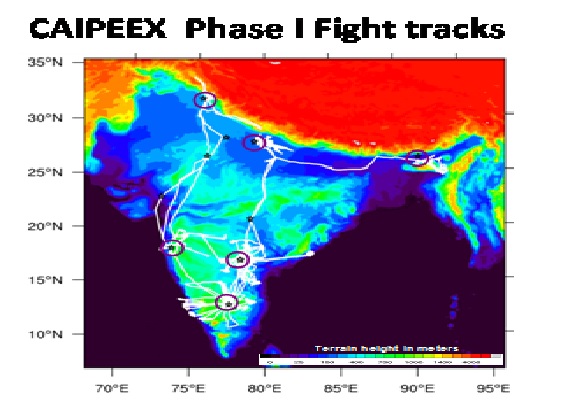
Airborne observations of cloud microphysical parameters, aerosol size distribution, cloud condensation nuclei (CCN) concentrations and environmental parameters such as temperature, humidity and winds were carried out with the help of a twin engine Piper Cheyene pressurized aircraft in 2009, which was exploratory experiment for two reasons. This was to survey the aerosol, CCN and cloud droplet characteristics over different parts of India and to identify a suitable location to conduct cloud seeding experiment (Kulkarni et al., 2012 for details).
Participants
The list of National steering committee members and participant scientists:
| 1. Dr. D. R. Sikka 40, Mausam Vihar, New Delhi - 110 051 drsikka@yahoo.com |
14. Air Vice Marshal. G. P. Sharma Principal Director, Directorate of Meteorology, Air Head Quarters (Vayu Bhavan) New Delhi 110011 pdmetgps@gmail.com Tel. 23091042 |
| 2. Dr. Ajit Tyagi Director General of Meteorology India Meteorological Department Mausam Bhavan, Lodhi Road, New Delhi 110003 ajit.tyagi@gmail.com |
15. Comm. Mahitosh Mishra Principal Director Directorate of Naval Oenology & Meteorology Integrated Head Quarters, Ministry of Defense, New Delhi - 110 011 Tel : 011-2301 0139 Fax : 011-2301 1663 |
| 3. Dr. B.N Goswami Director Indian Institute of Tropical Meteorology, Dr. Homi Bhabha Road, Pashan, Pune 411 008 91-020-25893924:Office 91-020-25885171 :Residence goswami@tropmet.res.in |
16. Dr. S.N. Tripathi Associate Professor Department of Civil Engineering Indian Institute of Technology Kanpur Kanpur-208016 snt@iitk.ac.in, tripathi_sn@hotmail.com Tel : +91 512 259 7845 (O) +91 512 259 8806 (R) +91 941 5050540 (m) Fax: +91 512 259 7395 |
| 4. Dr. R. R. Kelkar ISRO Chair Professor Department of Atmospheric & Space Sciences, Univeristy of Pune Ganeshkhind, Pune - 411 007 rrkelkar@unipune.ernet.in |
17. Dr. Manchanda Chairman, TIFR Balloon Facility Committee and Balloon Facility Management Board, National centre for environmental sciences and payload engineering, Hyderabad - 500 062 ravi@tifr.res.in Tel. 22 22782403/ 22782618 |
| 5. Dr. Jayaraman Director National Atmospheric Research Laboratory Gadanki - 517 112, Chittoor District Andhra Pradesh, India. jayaraman@narl.gov.in Phone : 8585-272 001 Fax :8585 272018 |
18. Prof. Ram Sagar Director Aryabhatta Research Institute of Observational Sciences (ARIES), Manora Peak, Nainital-263 129 sagar@aries.ernet.in Tel: +91-5942-233734, 233735, 233727, 232655 Fax: +91-5942-233439 |
| 6. Prof. G. S. Bhat Chairman Center for Atmospheric and Oceanic Sciences (CAOS) Indian Institute of Science (IISC) Bangalore - 560 012. bhat@caos.iisc.ernet.in Phone : 080 23600450 , 080-2293 3071 Fax: 091-80-23600865 |
19. Dr. Hatwar ADGM (R) India Meteorological Department, Shivajinagar, Pune - 411 005. Tel. 25535211 |
| 7. Prof. P. V. Joseph UGC visiting Professor, Department of Atmospheric science, Cochin University of Science and Technology, (CUSAT),Fine Arts Avenue, Cochin - 682 016 porathur@md4.vsnl.net.in Tel. 0484 353662 (o) 0484 422108 |
20. Dr. Vashishta DDGM (SI) India Meteorological Department Shivajinagar, Pune - 411 005 ramdhanv@hotmail.com Tel. 25535211 |
| 8. Dr. A. K. Bohra National Centre for Medium Range Weather Forecasting (NCMRWF) A50, Sector 62, Institutional Area, Phase II, Noida - 201 301 UP akbohra@ncmrwf.gov.in Tel. 0120 2403611 Fax 0120 2400062 |
21. Dr C. B. S. Dutt Dy Programme Director, ISRO-GBP & Member-Secretary, JSWG-MT-ISRO Room No. 141, ISRO Headquarters Antariksh Bhavan, New BEL Road Bangalore 560 094 dutt_cbs@isro.org |
| 9. Prof. M.M. Sarin Physical Research Laboratory Navrangpura, Ahmedabad - 380 009, India sarin@prl.res.in Tel:079 26314000, 26302129. Fax: +91 79 2631 4900 |
22. Dr. M.K. Bhatnagar Director, Aviation Services, India Meteorological Department Mausam Bhavan, Lodhi Road, New Delhi 110003 mkb@imdmail.com, bhatnagarmk1@gmail.com |
| 10. K. Krishnamoorthi Scientist SG Space Physics Laboratory (SPL) Vikram Sarabhai Space Centre (VSSC) Thiruvananthapuram - 695 022 Kerala krish229@eth.net, krishnamoorthy_k@vssc.gov.in Telephone, Office : (0471) 256 2404, Residence : (0471) 232 3542 Fax: (0471) 270 6535 |
23. Dr. Vidyadhar Mudkavi Computational & Theoretical Fluid Dynamics Division (CTFD) National Aerospace Laboratories P. B. No. 1779, Bangalore 560017 vm@ctfd.cmmacs.ernet.in Tel : 080-25051624 |
| 11. Dr. Rajeevan Scientist-SG National Atmospheric Research Laboratory Gadanki - 517 112, Chittoor District Andhra Pradesh, India. rajeevan@narl.gov.in Tel : 8585-272 026 Fax :8585 272018 |
24. Dr.S. Sampath Head, Atmospheric Sciences Division, Centre for Earth Science Studies, Akkulam Trivandrum - 695 031 sampath.sar@gmail.com Ph : 0471-2442451 |
| 12. Dr. Swati Basu Advisor/Scientist-G Ministry of Earth Sciences Block No. 12, Mahasagar Bhawan C.G.O. Complex, Lodhi Road 110003 swati.basu@nic.in, swatimes@gmail.com Tel : 011-24610746; Telefax: 24611560 |
25.Dr. V. S. Prakash Director , Karnataka State Natural Disaster Management Cell 9th Floor, BWSSB Building, Kaveri Bhavan Bangalore - 560 009 Prakash.vshiva@gmail.com |
| 13. Dr. Pradeep Kumar Head, Department of Atmospheric & Space Sciences University of Pune,Ganeshkhind,PUNE-411 007 hod@dass.unipune.ernet.in, ppk@physics.unipune.ernet.in Tel: +91-20- 25697752, 25601374, 25692678 (326) Fax: +91-(020) 25691684, 25691712 |
26.Dr. S.H. Damle Retd. Associate Director, SAMEER Flat No. 704, TARA TOWERS Near Swapna Shilp Complex Kothrud, Pune - 38 sureshdamle.2007@rediffmail.com Phone : 020-25463074 Mobile : 09422516677. |
Aircraft used in Phase I
Specifications of the Aircraft
The caipeex aircraft N361 JC is a pressurized one and have housing instruments, crew team, scientists and engineers. The aircraft has capacity for carrying 2 pilots + 3 (engineers and scientists). The aircraft crew and other scientific and engineering staff is:
- One pilot/Co-pilot
- One Instrument Engineer
- One IITM Scientist
Operational Requirements
| Parameter | Value |
| Lower Altitude | 500 ft |
| Higher Altitude (at least) | 22000 ft |
| Cruising Speed | 240 knots |
| Sampling Speed | 100 m/s |
| Ascent rate | 300ft/min |
| Endurance | 3-5 hours |
| Range | 3000 km |
Aircraft used
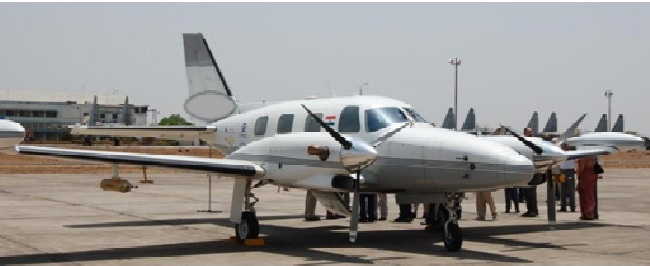
A twin engine Piper Cheyenne model PA-31 T instrumented aircraft (Figure 2) was utilized in the program. The aircraft was certified for flying into known icing conditions, and had a pressurized cabin. It had capacity to carry a scientific crew of four persons, and climb up to a maximum altitude of 28,000 feet, with a range 1200 nautical miles, and endurance of 5 hours with scientific payload. The minimum rate of climb was 200 feet per minute.
Daily Routine:
Generalized Daily Operation Routine
The daily routine was controlled, guided and monitored by the Operation Director, who was the senior scientists from the IITM / participating institutions. Summary of the daily operations is as follows.
- Operations started up with early monitoring of forecasting charts, soundings, overnight radar pictures, etc.
- Daily briefing including forecast, equipment status, scientific strategy for the day's operations, debrief on key issues of previous day operations, weekly recap on overall progress toward observational goals or quotas, etc.
- Expected sequence: 8.30 a.m. weather briefing, past operation's de-briefing equipment status, strategy for current day.
- Declaration of start or stop the operation: Operation Director, is deciding the operation, taking in to consideration the forecast information, equipment status, crew status and scientific needs.
- Designating a down day's to be done ~ 24 hours or more in advance, based upon forecast information, overall needs of the project, overall personnel needs for rest time.
- Providing documentation of daily key functions for archival : Forecaster to provide forecast materials for digital archive; Operation Director will supervise the maintenance of routine logs;
- Flight scientists maintained flight logs.
Flight strategies overview
Flight operations were undertaken to accomplish a range of observation needs including:
- Instrumentation tests and Intercomparison.
- Ambient aerosol research survey flights
- Cloud and aerosol research flights
Instrument Flight Tests: Instrument tests were carried out regularly